



Ecological Compensation supports more responsible mining
10 November, 2025
Minimizing environmental impacts is a core principle of the Sakatti Project. As a pioneer in ecological compensation, the project is exploring innovative ways to offset the ecological degradation caused by mining activities.

In planning of the Sakatti mining project, numerous measures have been identified to avoid environmental impacts caused by the mine. Impacts that cannot be avoided are mitigated as far as possible. If mitigation is not feasible, the areas will be rehabilitated to their natural state after the operations have ended, to the greatest extent possible.
Supporting Biodiversity through Compensation Planning
In addition to avoiding and mitigating environmental impacts, the Sakatti mining project includes plans for ecological compensation measures aimed at enhancing biodiversity elsewhere. Compensation is a way to offset adverse effects that cannot be fully avoided or mitigated.
Sakatti mine will require a Natura 2000 derogation permit from the Finnish Government. This, in turn, requires a compensation and offsetting plan approved by the authorities. The company is currently preparing a Natura compensation plan as part of the regional land use planning process.
The Sakatti polymetallic deposit is partially located beneath the western edge of the Viiankiaapa mire. How is it even possible to compensate for the conservation values of a Natura area?
“We are evaluating a wide range of methods to avoid and reduce the negative ecological impacts of our operations. One of the key measures to reduce impacts on the hydrology of the mire—and thereby on biodiversity—has been to exclude a satellite deposit located closer to the surface from the mining plan. In addition, modern mining and environmental technologies offer further opportunities to reduce impacts,” says Ulla Syrjälä, Head of Sustainability for the Sakatti mining project.
“Mining operations inevitably reduce the living space of certain habitats and species. In some cases, it is possible to restore the habitats later enabling species to recover. For some species, suitable measures can be taken to expand their habitat or improve the habitat quality. Ultimately, the way to compensate for the harm is to generate ecological value and strengthen biodiversity in another location.”

Ulla Syrjälä, Principal Safety & Sustainable Development of Anglo American’s Sakatti Project
Anglo American has a corporate-level commitment of achieving a net positive impact (NPI) on biodiversity in all its new projects as well as in its existing mining operations. This means that by the end of Life of Mine, there should be an increase in biodiversity in the area compared to baseline. Therefore, the Sakatti Project also considers how biodiversity—including the preservation of species, habitats, and genetic diversity—can be improved as a whole.
Voluntary Ecological Compensation Measures
In 2023, Anglo American initiated voluntary ecological compensation for the Sakatti mining project by acquiring and protecting nearly 3,000 hectares of old-growth forest in Inari, Lapland. This area compensates for the impact of the mine on the commercial forest outside the protected area. This remains the largest voluntary ecological compensation effort in Finland.
The company is also planning ecological compensation measures for mire ecosystems, with the intention of implementing these voluntary actions primarily in the local Sodankylä region.
Voluntary ecological compensation also includes the compensation of ecosystem services.
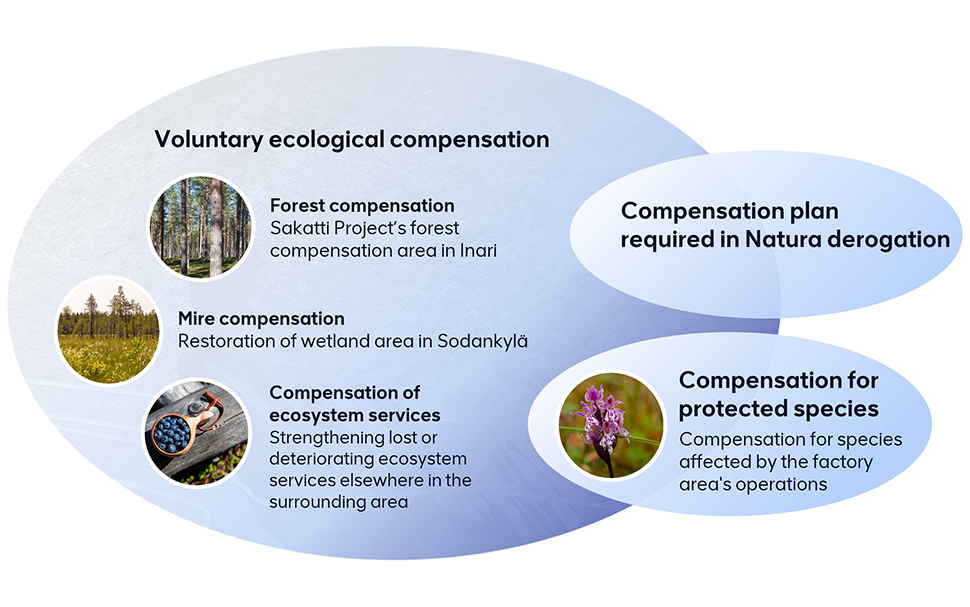
Ecological compensation measures in the Sakatti Project
Residents Involved in Proposing Ecosystem Service Compensation Measures
“We consider it important that local residents—those living in areas affected by the project—can participate in planning the compensation of ecosystem services. During this year, we have organized ecosystem workshops and a survey where residents were invited to mark on a map the ecosystem services that are important to them—that is, the benefits provided by nature—and to suggest ways to compensate for them,” says Ulla Syrjälä.
Compensation methods were previously explored during the environmental impact assessment process.
In the ecosystem service workshops, the most popular compensation proposals focused on improving recreational use of water bodies, increasing opportunities for physical activity and hobbies, preserving nature and landscapes, and enhancing roads and transportation. For example, repairing a road can improve access to ecosystem services in other nearby areas.
To initiate the planning of ecosystem service compensations, the goal over the next two years is to establish ecosystem service working groups in collaboration with residents of the villages of Sattanen, Kersilö, and Moskuvaara. Together, they will consider which compensation measures should be prioritized in their communities. After that, the aim is to begin implementing the first actions.

In the ecosystem service workshops held in spring 2025 in Sattanen and Moskuvaara, participants marked ecosystem services located within the Sakatti mining project's impact area on a map.
A New Ecological Approach
In Finland, the rules for voluntary ecological compensation were established in the Nature Conservation Act in 2023 and in a complementary decree. The legislator has aimed to ensure that:
- The area or quality of habitats or locations of protected habitat types or species would be preserved despite human activities.
- The costs of harm caused by industrial activities would be directly included in the implementation costs of the project.
- Voluntary biodiversity conservation would also be part of credible responsibility work.
What Are Ecosystem Services?
Ecosystem services are divided into provisioning, regulating, supporting, and cultural services.
Provisioning services include, for example, berry picking, hunting, fishing, and the production of crops and timber.
Regulation services control natural phenomena such as water flow, flooding, and the provision of shade.
Supporting services include photosynthesis and oxygen production, air purification, carbon sequestration, nutrient cycling, soil formation, and the decomposition of organic matter.
Many intangible benefits provided by nature are cultural services, which enhance well-being and health and are also important from a tourism perspective.
Definitions
Ecological compensation:
Involves restoring, creating, or managing ecosystems elsewhere to replace lost ecological value, if the harm cannot be entirely avoided or mitigated.
Net positive impact on biodiversity:
The overall effect of a company’s operations results in more benefits than harm to biodiversity.
For additional information on the Finnish perspectives on ecological compensation, please visit at the Finnish Ministry of Environment website:
https://ym.fi/en/ecological-compensation
This article was published (in Finnish) on November 5, 2025, in Malmisanomat 2/2025. Malmisanomat is a commercial newsletter for mining sector operators in Laplan.