



Why the Sakatti Mine?
25 September, 2026
The Sakatti Project has reached an important stage: to proceed, it requires a derogation from Natura 2000 protection. The proposal concerning this derogation is currently undergoing public consultation and will soon be considered by the Finnish Government. The Government may approve a derogation from Natura protection if the project is deemed to be of overriding public interest, its impacts have been minimised, no alternative solution exists, and the remaining impacts can be compensated in a manner that safeguards the integrity of the Natura network.
The Sakatti deposit is located beneath the western edge of the Natura 2000 protected Viiankiaapa mire, at a depth of approximately 250-1,250 metres. Viiankiaapa represents the aapa mire ecosystems typical of Central Lapland and is one of six valuable aapa mire complexes located wholly or partly within the municipality of Sodankylä.
In recent years, public discussion has focused on the impacts of the Sakatti Project and the broader principles of nature conservation. We believe it is important that discussions concerning the project are based on the most comprehensive and up-to-date project-specific information available.
This article brings together the key facts about the Sakatti Project and its environmental, social and economic impacts.
Explore the planned Sakatti mine and its key environmental impacts through a new four-minute animation.
Sakatti: An Underground Mine Designed with Respect for Nature
The Sakatti deposit is not exceptionally large, but it is exceptionally rich. Its high mineral concentrations enable entirely underground mining and therefore a relatively small environmental footprint, as more metals can be produced with less excavation.
- The Sakatti underground mine will have no surface structures within the protected area. Ore will be mined underground, while the processing plant area will be located outside the protected area.
- All materials, equipment, personnel, water and ventilation will access the mine through an underground decline tunnel more than five kilometres long. The tunnels will be sealed, a significant proportion of water will be recycled, and all discharge water will be treated. No water will be released into protected areas, even after treatment.
- Mined-out voids will be backfilled by returning waste rock and tailings underground as paste backfill. Part of the waste rock will be used for local infrastructure construction. The remaining tailings will be filtered and stored dry, facilitating water management.
- The planned mine will make extensive use of electrified solutions, supporting our carbon neutrality ambitions.
- The northeastern mineral deposit located closer to the surface will not be mined at all, significantly reducing the project's impact on nature.
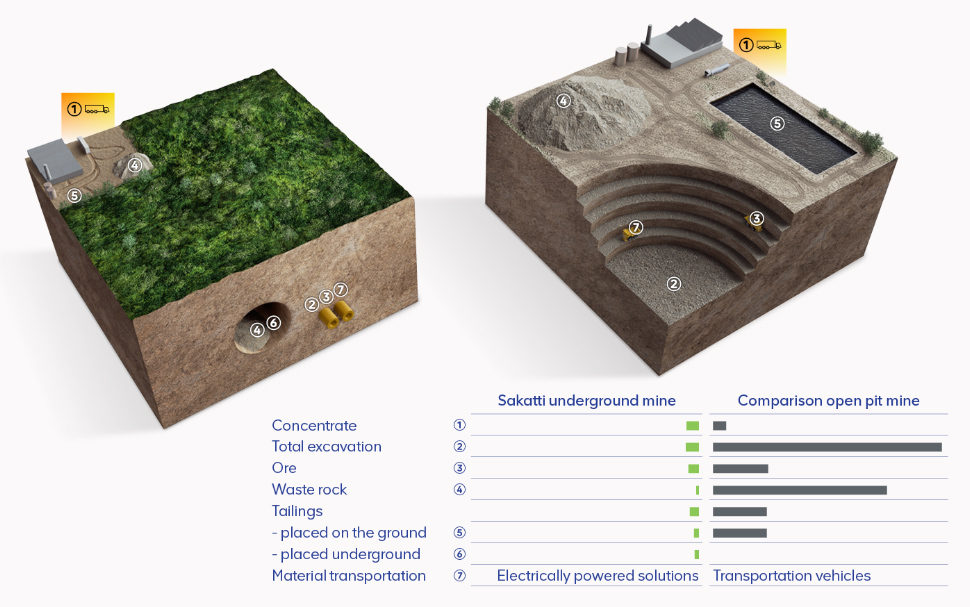
The environmental impacts of the Sakatti underground mine are significantly smaller than those of a comparable open-pit mine.
Estimated Hydrological Impacts on Approximately Four Per Cent of the Natura Area
The project's impacts on the Natura area have been assessed in the updated 2025 Natura Assessment for the Sakatti Project.
- Keeping the decline tunnel, underground mine and quarry for construction materials dry is expected to cause local changes in groundwater flow directions and groundwater levels. At their maximum extent, potential hydrological impacts are estimated to affect approximately four per cent of the Natura area and are expected to be largely minor. Following mine closure, groundwater levels are expected to return to their pre-mining condition, and environmental changes will be monitored not only throughout the mine's life cycle but also long after closure.
- According to independent experts and the environmental authority, impacts on the most sensitive mire habitats and species on the western edge of Viiankiaapa cannot be entirely ruled out.
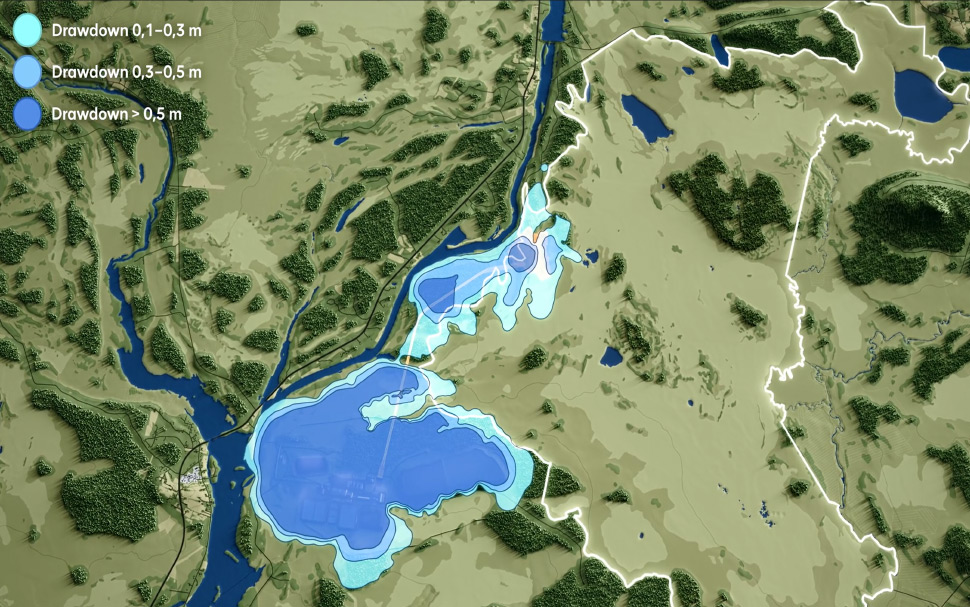
The Natura Assessment estimates that potential hydrological impacts would reach their maximum extent during the mine's 24th year of operation and affect approximately four per cent of the Natura area, primarily as a minor groundwater drawdown of 0.1-0.3 metres.
The Natura Area Would Expand by One Third
The Sakatti Project does not seek to remove Natura protection from the Viiankiaapa area. Through the compensatory measures required for a Natura derogation, the extent and integrity of the Viiankiaapa Natura network would be maintained.
- Environmental impacts that cannot be avoided will be compensated in accordance with the principles of voluntary ecological compensation under the Nature Conservation Act and using scientifically validated ecological compensation methods developed through the BOOST project¹.
- Areas designated for compensatory measures will be incorporated into the Natura network, increasing the area of the Viiankiaapa Natura site by one third.
- The protected area will continue to be available for recreation and reindeer husbandry as before.
- In addition to the compensatory measures required through the permitting process, we are committed to achieving a net positive impact on biodiversity. The project's first voluntary ecological compensation plan was published in 2020 as part of the Environmental Impact Assessment. To advance this goal, we have already protected nearly 3,000 hectares of old-growth forest in Inari to compensate for the impacts of the planned processing plant area on managed forests. We will also continue voluntary biodiversity enhancement measures by protecting mire habitats in Sodankylä during the mine's operational phase.
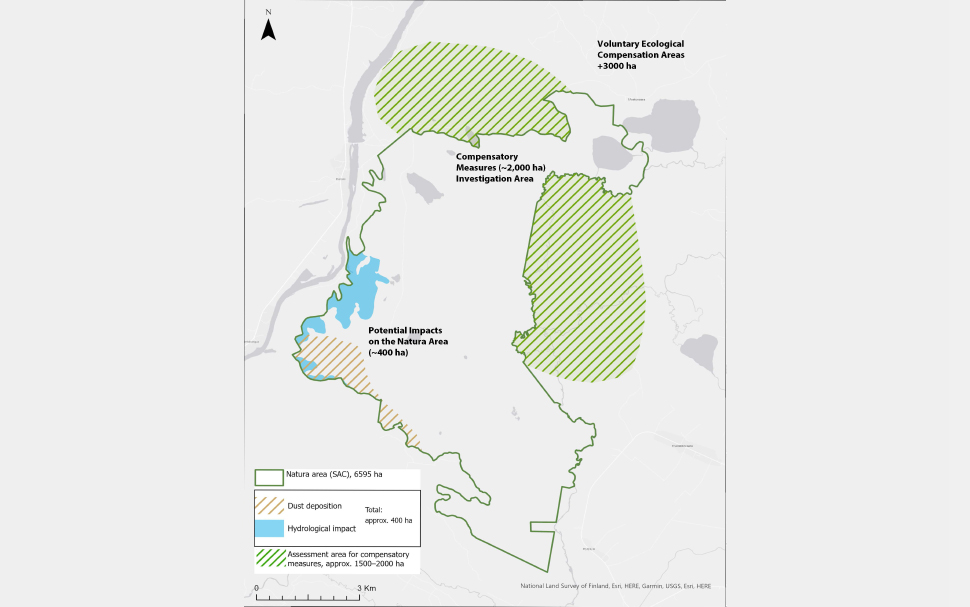
The potential impacts of the Sakatti mine would extend to approximately 400 hectares of the Viiankiaapa Natura area. These impacts are planned to be compensated through measures implemented across approximately 2,000 hectares, which have been scientifically evaluated¹ as sufficient to offset the environmental impacts.
The Mine Is Important Not Only Regionally, but Also for Finland and Europe
Global competition for critical minerals is intensifying. Europe must strengthen its mineral self-sufficiency, as the EU consumes 20% of the world's minerals while producing only 3%.
Of the metals contained in the Sakatti deposit, copper and nickel in particular are classified as critical raw materials by both Finland and the EU. In 2025, the project was granted Strategic Project status under the EU's new Critical Raw Materials Act (CRMA), reflecting its importance in strengthening Europe's raw material security, strategic resilience and energy transition.
- Once production begins in the early 2030s, the Sakatti mine will double Finland's copper production and increase nickel production by one quarter.
- If realised, the project is expected to increase Finland's GDP by approximately EUR 490 million. National tax revenues are estimated at approximately EUR 75-80 million annually. A significant share of these benefits would be generated in Lapland, where the mine would increase municipal tax revenues in Sodankylä and strengthen regional vitality².
- The mine would create approximately 350 permanent jobs. In addition, it is expected to support employment for 480-2,010 people across the mining value chain during most years of operation.
- The mine would support the development of Finland's mineral value chain and enable the creation of greater domestic added value.
More Than 20 Years in Finland
Anglo American has operated in Finland since 2004 and has been developing the project in close cooperation with authorities, the Municipality of Sodankylä and local communities for more than 20 years. The project has followed the standard permitting and regulatory processes applicable to mining projects.
The Finnish subsidiary responsible for the Sakatti project already employs more than 60 people in Finland and has invested approximately EUR 300 million in the country over the years. The total investment in the project is estimated at EUR 1.3-1.5 billion.
We are committed to long-term cooperation that respects local communities and environmental values, and support for the project among local stakeholders is strong (as demonstrated by a long-term study conducted by the University of Lapland³ and a recent public opinion survey commissioned by the Municipality of Sodankylä and carried out by Taloustutkimus Oy⁴). We were also the first mining project in Finland to establish a formal cooperation agreement with the municipality.
The Project Is Proceeding in Accordance with Legislative Requirements
Strategic Project status may help streamline permitting procedures, but it does not reduce the requirements imposed by legislation or regulations in any way.
Natura 2000 sites enjoy strong legal protection. However, the system also includes a formal derogation procedure, which is widely applied across Europe when the conditions established in legislation are met.
References
1 BOOST Project's website (25 Sep 2026) - in Finnish
2 Economics Study of the Sakatti Mine 2026 (Copenhagen Economics)
3 Perceived Impacts of Mining in Sodankylä: Survey Study 2016-2025. Sodankylä Municipality (University of Lapland) - in Finnish
4 Sodankylä Residents Are Generally Positive Towards Mining Projects but Expect Case-by-Case Assessment and Conditions. Public Opinion Survey 2026. Sodankylä Municipality (Taloustutkimus Oy) - in Finnish