



The Sakatti Mining Project has a Substantial Economic Impact
01 July, 2026
The Sakatti mining project is strategically important for both Europe and Finland, but its economic significance is particularly pronounced in Lapland, where it is expected to deliver considerable regional economic benefits.
The Sakatti mine would produce not only copper, nickel and cobalt, but also valuable metals such as platinum, palladium, gold and silver. These minerals are essential for a wide range of applications, including energy technologies, power transmission and storage, stainless steel production, electric vehicle batteries, water purification, medical devices and pharmaceuticals, and information technology.
The economic benefits of the mine arise both from the extraction of ore and the production of mineral concentrates, as well as from downstream processing and refining activities. Finland already has a strong mineral-processing industry and a broad network of companies operating throughout the domestic value chain.
The project's economic impacts can also be viewed geographically. Some benefits will be generated locally within the host community, others regionally and nationally, while the project will also contribute to international trade through imports and exports.
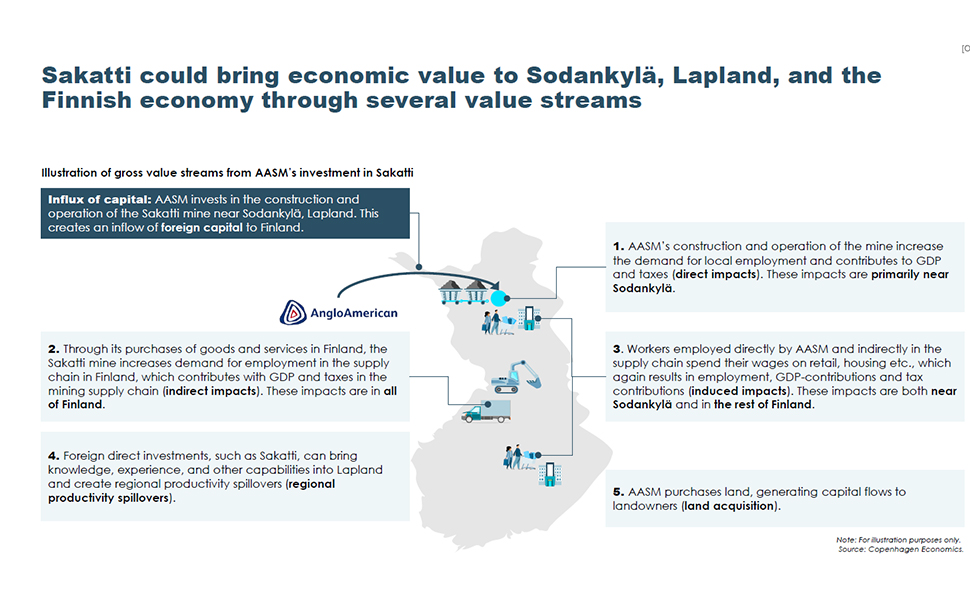
A Significant Contribution to the Local Economy
The economic benefits to the local community will be driven largely by tax revenues and the procurement of goods and services.
A key principle of Anglo American’s operating model is to maximise the use of local suppliers wherever possible. Even during the project development phase, procurement spending in Sodankylä has been significant. For example, approximately €636,000 worth of services were purchased from Sodankylä-based businesses in 2025.
At the national level, economic benefits will arise not only through tax revenues but also through increased business activity across the entire metals value chain.
Creating Significant Employment
The Sakatti mine is expected to create approximately 350 permanent jobs in Sodankylä.
In addition, the project is estimated to support employment for between 500 and 2,800 people annually throughout the value chain during most years of operation. This includes jobs in mining technology manufacturing, specialist service providers, mineral processing and refining, and related industries.
Large-scale mining projects also require extensive expertise during the planning and development phase. The Sakatti project currently employs approximately 65 full-time staff, and the team is expected to continue growing as project planning advances.
Construction Phase Will Attract New Residents and Economic Activity
The construction phase of the mine will significantly increase employment and economic activity in the region.
Beyond demand for engineering expertise, construction materials, machinery and equipment, construction workers will require accommodation, catering services, transportation and recreational opportunities. These needs will increase demand for local businesses and services across the municipality.
Employment Generates Tax Revenue for Municipalities and the State
A proportion of the mine’s future workforce is expected to settle permanently in Sodankylä. Municipalities where employees reside will benefit from population growth and increased tax revenues.
Like all wage earners in Finland, mine employees will pay income tax to the state. Tax contributions generally increase with earnings.
Based on average salary levels in the mining sector and the tax rates applicable in 2026, a mine employee residing in Sodankylä would pay a municipal tax rate of approximately 7.5%. Depending on individual income, family circumstances and assets, state income tax would typically add approximately 15–20% of salary.
Corporate Tax Revenues
Once operations commence, Sakatti will pay corporate income tax in Finland on any profits generated by its business activities.
According to an analysis by Copenhagen Economics, the Sakatti mine could contribute an average of approximately €65–70 million per year in tax revenues to Finland throughout its operational life. Of the taxes paid by the mine, approximately €20 million annually is estimated to remain in Northern Finland.
Future corporate tax revenues will depend significantly on mineral prices in global markets during the 2030s and beyond, after the mine reaches full production.
Finland’s corporate income tax rate is 20% in 2026, decreasing to 18% in 2027. Approximately 65% of corporate tax revenues accrue to the state, while municipalities receive roughly one-third.
In December 2025, Business Finland granted the Sakatti project a €150 million tax credit under Finland’s major clean transition investment incentive programme. This benefit will only become available once the project has completed the required permitting processes and reaches full operational status.
Mining Mineral Tax Benefits Both the State and Municipality
In addition to corporate income tax, the mine will generate revenue through Finland’s mining mineral tax.
Expert estimates indicate that the Sakatti mine’s annual net contribution through mining mineral tax could amount to approximately €20 million per year. Under the current framework, 80% of mining mineral tax revenue is allocated to the Finnish state and 20% to municipalities.
Under the current system, the annual net regional impact in Lapland is estimated to be approximately €8 million.
Future Revenues Depend on Market Conditions and Policy Decisions
The profitability of mining operations is highly dependent on future global commodity prices.
Similarly, the revenue generated through mining mineral taxation will be influenced by tax policy decisions and annual revenue targets set by Parliament as part of the broader management of Finland’s public finances.
Additional Economic Contributions
Beyond corporate income tax and mining mineral tax, the mining company will contribute through property taxes paid to the municipality, employer social security contributions, electricity taxes, fuel taxes and compensation payments to landowners related to mineral exploration and land use.
These impacts have not yet been included in the economic estimates outlined above, as they can only be reliably assessed once project planning and engineering have progressed further.