



Enhancing Biodiversity Values
13 May, 2026
The Sakatti Project’s plan to compensate for impacts on nature is linked to the regional phased land use plan proposal prepared by the Regional Council of Lapland. The core principle of the plan is to enhance biodiversity values, not merely compensate for the adverse impacts of mining.
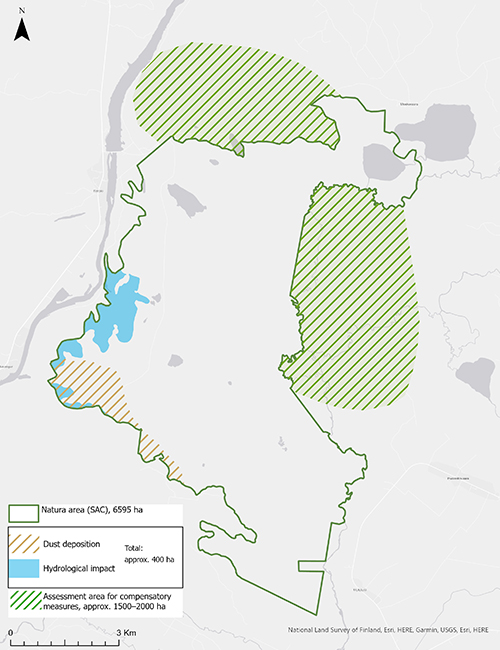
The dust deposition and hydrological impact areas modelled in the Natura assessment are located on the western edge of the Viiankiaapa Natura area.
Potential impacts of mining on the conservation objectives of Viiankiaapa were defined in an updated Natura assessment published in February 2025. Our subsequent planning has incorporated additional input provided by the ELY Centre and Metsähallitus in their statements. Despite mitigation measures, when applying the precautionary principle, the possibility of impacts on the western edge of the Natura area could not be ruled out.
In line with the European Commission’s Habitats Directive, any potential adverse impacts on a Natura area must be compensated for in advance.
The Sakatti Project is committed to compensating for the assessed impacts—but has set an even higher ambition: to increase biodiversity values beyond the level of any negative impacts caused by mining.
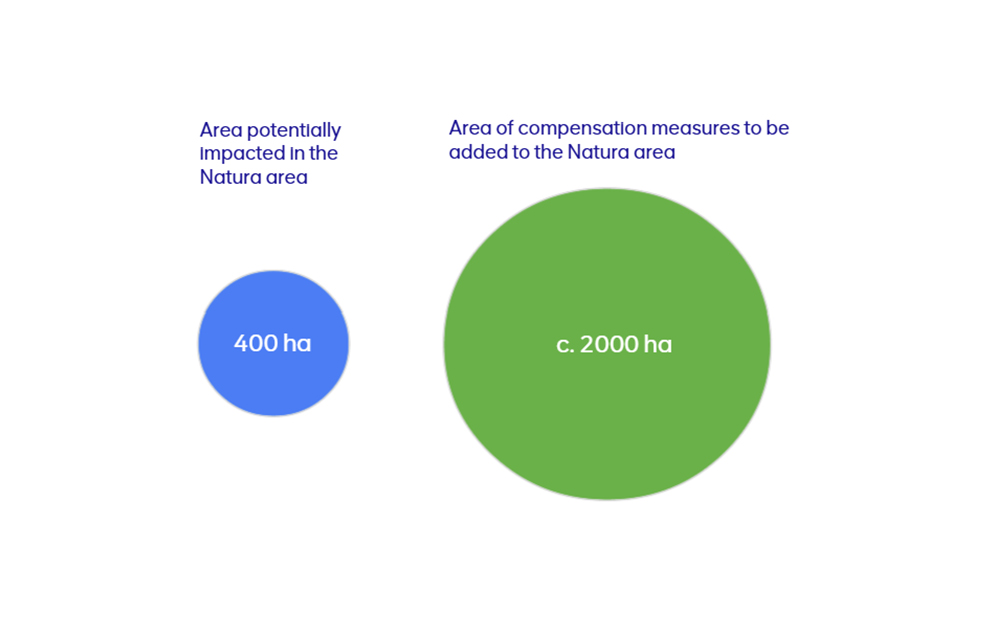
The planned compensation area is larger than the estimated impact area.
The EU provides guidance on the planning of compensations
According to European Commission guidance, compensatory measures must be ecologically effective, timely, and appropriately located in relation to the project’s impact area.
They must target the same habitat types and species that may be adversely affected, as well as the specific conservation features for which the Natura area was designated.
It is not sufficient for compensation measures to be located within the same biogeographical region; the compensation area must fulfil the same ecological function as the original area.
The implementation of compensatory measures will be monitored over several decades to ensure that biodiversity develops as planned. Therefore, the measures must be designed so that their effectiveness can be measured and tracked.
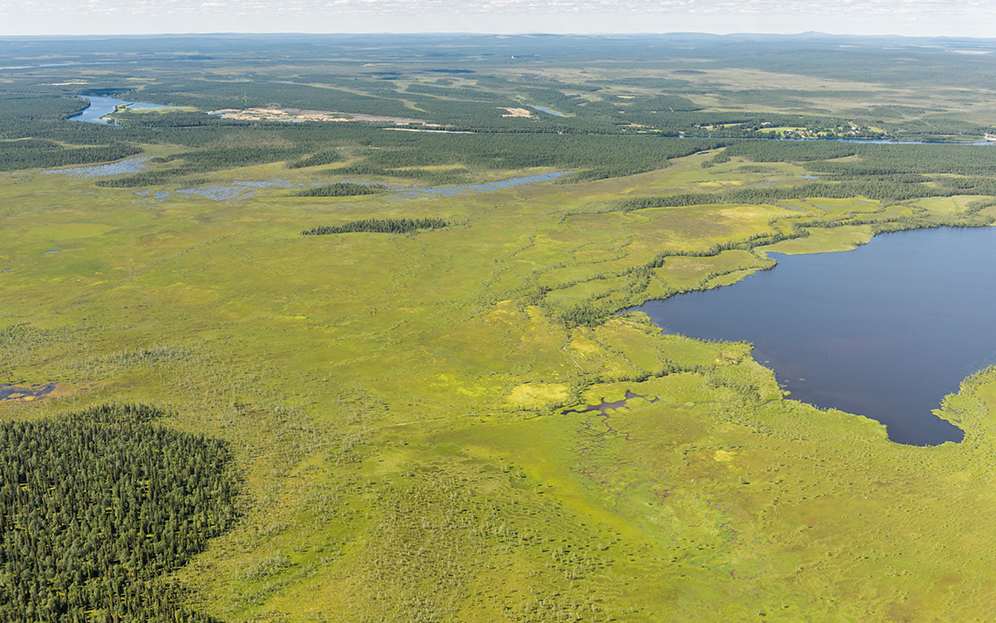
As a habitat type, the aapa mire is one of the conservation criteria of the Viiankiaapa Natura area.
Measuring Impacts: Biodiversity Value Hectares
Impacts and benefits to nature are assessed using the unit biodiversity value hectare. Both the biodiversity value lost and the value generated through compensation measures are calculated. These are quantified as biodiversity value hectares.
The more natural the condition of a one-hectare area, the higher its biodiversity value. Calculations are made for the baseline situation (before construction begins), and for the situation where the impacts of mining are at their greatest.
The difference between these values defines the number of biodiversity value hectares that must be compensated. Impacts and benefits are assessed per conservation feature, meaning separately for each habitat type or species.
Compensation Close to Viiankiaapa
Areas whose natural state has been degraded due to human activity will be restored to move them closer to their original condition. Habitat restoration improves the viability of species that form part of the conservation basis.
Losses to the Viiankiaapa Natura area are proposed to be compensated in its surrounding areas. Final decisions on compensation sites and measures will be made as the process progresses.
Compensation measures include ecological restoration, habitat rehabilitation and an ex situ conservation project for moss species (Meesia longiseta, Hamatocaulis vernicosus and Scorpidium scorpioides) in cooperation with the University of Oulu.
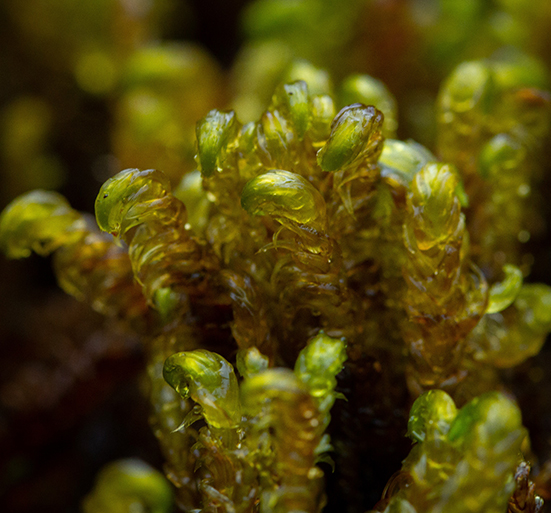
Scorpidium scorpioides. Photo: Osmo Heikkala
Monitoring and Oversight
Restoring biodiversity is a long-term process. The implementation of the compensation plan will therefore be carefully monitored, particularly regarding hydrology of the mire ecosystem and conservation objectives. Monitoring ensures that the integrity of the Natura network is maintained.
In Finland, implementation is supervised by the Licensing and Supervision Authority (LVV). Compensatory measures required under the Nature Conservation Act are subject to official regulatory oversight.
Towards a Net Positive Impact
The company’s overall objective is to achieve a net positive impact on biodiversity. The mandatory compensation measures required for Natura derogation are complemented by voluntary compensation measures addressing impacts outside the Natura area. The company has already protected 3,000 hectares of old-growth forest in Inari to offset impacts of a planned industrial area outside Natura on forest ecosystems. Additional measures are planned for peatland areas outside the Natura zone.
The Licensing and Supervision Authority (LVV) began operations at the start of 2026, combining permitting and supervisory functions previously carried out by several authorities. It is responsible for environmental, social and health, occupational safety, education, and other supervisory tasks in Finland.